


Westside Cowboy : It Goes On Review
by Shannon Smith
 There is a useful distinction between a band having a lot going on and a band knowing how to make a few things work together. Westside Cowboy spends much of It Goes On demonstrating the latter. Guitar figures repeat, chord progressions remain accessible, and individual instrumental parts rarely call attention to their difficulty. The music expands and contracts with the source of that movement becoming apparent: Westside Cowboy treats the ensemble itself as an arranging instrument.
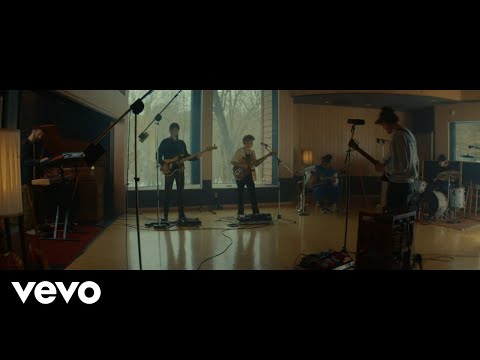
That quality emerges through “Kick Stones.” A guitar pedal tone establishes the opening foundation before the rest of the band begins filling the space around it. A second guitar works higher figures against that foundation rather than simply doubling it, while Paddy Murphy uses a rolling rock pattern between the snare and toms. Aoife Anson O’Connell’s bass provides the harmonic floor underneath the guitars. Each musician is doing something readily understandable on their own, but their different functions make the combined texture larger than any one part.
Reuben Haycocks’ lead vocal extends the same principle. His timbre has a strong presence without needing an exaggerated delivery, and its directness suits the band’s guitar-centered sound. When Anson O’Connell’s voice joins him, the contrast between their timbres changes the scale of the arrangement. Another differentiated voice has entered an already developing texture. As the guitars move toward fuller strumming and the vocal harmonies accumulate, dynamics and density carry “Kick Stones” from its quieter beginning toward its climax.
That approach is fundamental to It Goes On. Complexity here frequently exists between the parts rather than inside them.
“Pin Up Boys” makes for another example of this point particularly well. Haycocks and Jimmy Bradbury divide the guitar texture into complementary functions: one guitar maintains a steady eighth-note figure while the other works in longer, sustained strums. These aren’t doubled parts designed simply to make the record sound bigger. They occupy different rhythmic spaces, and the distinction widens the music naturally. Westside Cowboy can increase the apparent size of an arrangement without continually introducing new material.
The band’s development of the song is equally revealing. When the form returns, the guitars are played with greater force and the instrumental activity increases. Murphy adds kinetic energy from the drums while Anson O’Connell’s bass keeps the growing arrangement grounded. More motion enters the performance, but the individual parts remain coordinated around their respective functions. The arrangement grows because the musicians alter the intensity and relationship of material that has already been established.
Then Westside Cowboy does something more interesting than simply getting louder. At the arrival point, the arrangement simplifies.
Anson O’Connell’s vocal begins working in counterpoint with Haycocks, repeating a small melodic movement against his lead while the surrounding texture opens. The change makes the climax feel like a destination rather than just the loudest portion of the recording. Accumulation produces the tension; subtraction defines the arrival. “Pin Up Boys” consequently feels as though it has traveled somewhere even though much of its underlying musical material remains intact.
This complementary guitar writing recurs throughout the album. Rock arrangements built around multiple guitars can easily collapse into reinforcement, with both instruments occupying essentially the same rhythmic and harmonic role. Haycocks and Bradbury instead create width through difference: motion can sit against sustained color, and activity in one register can play against space in another. The arrangement, rather than instrumental display, becomes the source of complexity.
“Dobro” places that approach in a bluesier setting and shifts Bradbury to the lead vocal. Its central rock figure supplies forward motion while the guitars interact through the instrumental passages and Anson O’Connell and Murphy anchor the feel underneath them. Harmonic color becomes especially important. Notes are allowed to hang against the harmony before resolving, with the expressive pull of sevenths giving otherwise direct material a subtle instability.
That suspension becomes more meaningful beside the lyric. “Dobro” repeatedly presents images of waiting and observation: an instrument on the stairs, cars flashing beyond a window, a man passing on the street, and finally someone sitting on the stairs and the edge of a bed wondering where another person has gone. The world outside keeps moving while the song’s central perspective remains caught in place.
The chorus reduces that uncertainty to an elemental request: if you care, come home.
Bradbury’s sustained phrasing gives the sparse language room to carry its emotional weight. The harmonic colors, meanwhile, can hover before finding resolution. Westside Cowboy never has to turn that connection into an obvious musical illustration. It is enough that lyrical waiting and harmonic suspension occupy the same emotional space.
Anson O’Connell’s harmonies above Bradbury deepen it further. They alter register and emotional weight at selected moments. In this sense, Westside Cowboy treats its voices much as it treats its guitars. Contrasting sounds retain their individual identities while producing a richer third texture through combination.
“Big Wheels” shows that the approach isn’t dependent upon aggressive guitar playing. Clean arpeggiated figures establish a lighter foundation, with bass and drums leaving considerable room around a firm rock backbeat. The warm vocal carries a pleasant major-scale melody over harmony that moves slowly enough for individual changes to acquire weight.
The lift toward the dominant becomes meaningful when the melody accents its seventh, allowing a relatively small harmonic change to carry disproportionate emotional force. Later, words give way to vocal syllables as harmony and melody become more tense. The band builds dynamically, but once again understands that release does not require another layer. The volume falls.
Across these songs, that instinct becomes one of Westside Cowboy’s most persuasive characteristics. The band knows how to add, but just as importantly, it knows when addition has accomplished its purpose.
That makes It Goes On interesting with Westside Cowboy’s particular branch of contemporary rock. Which comes from how Haycocks, Bradbury, Anson O’Connell, and Murphy think together. There are recognizable pieces of rock vocabulary everywhere: pedal tones, repeating guitar figures, backbeats, three-chord movement, vocal harmonies, blues-derived colors, and dynamic builds. None of those elements alone establishes an identity. Their organization does.
It Goes On is deceptive. The band’s personality packed with information. It resides in the interaction between the four musicians listening to where the other parts sit. That may be the clearest achievement of It Goes On: Westside Cowboy becomes bigger not by having everyone say more, but by making every part matter.


Westside Cowboy
It Goes On
August 21, 2026
Island Records